-
Startseite -
-
En
-




-
En

The Lippeverband
River basin management from the beginning
The Lippeverband was founded on 19 January 1926, as a water management association for the middle and lower sections of the Lippe river. From the start, we cooperated closely with the Emschergenossenschaft, which is the oldest German water association. The two associations work together under the aegis of a harmonised organisational structure. The Lippeverband is a public sector entity, paid for by its members – which include cities, municipal administrations, mining organisations and businesses. We have been active in our region for a hundred years. On the basis of this experience, we reliably deliver services in the context of the public sector – without profit orientation and in the public interest.
Safe, clean and economical
In the environment around the Emscher and Lippe rivers, the needs of humans and nature are competing. As developers for the region, we want to achieve a sustainable balance bet-ween these needs. Living and working here should be just as possible as restoring ecologically friendly river land-scapes that abound with life – no simple task in a region that, were it not for our work, would regularly be underwater.
Located in the largest metropolitan area in Europe, between Holzwickede and Dinslaken, and in the neighbouring Lippe Region to the north, we are a modern and cost-effective water management organisation with a wide range of tasks:
• Wastewater treatment
• Care and maintenance of waterways
• near-natural restructuring of open sewers
• Flood protection
• Regulation of water drainage
• Management of groundwater and stormwater
• returning industrial river landscapes to nature
The Lippe
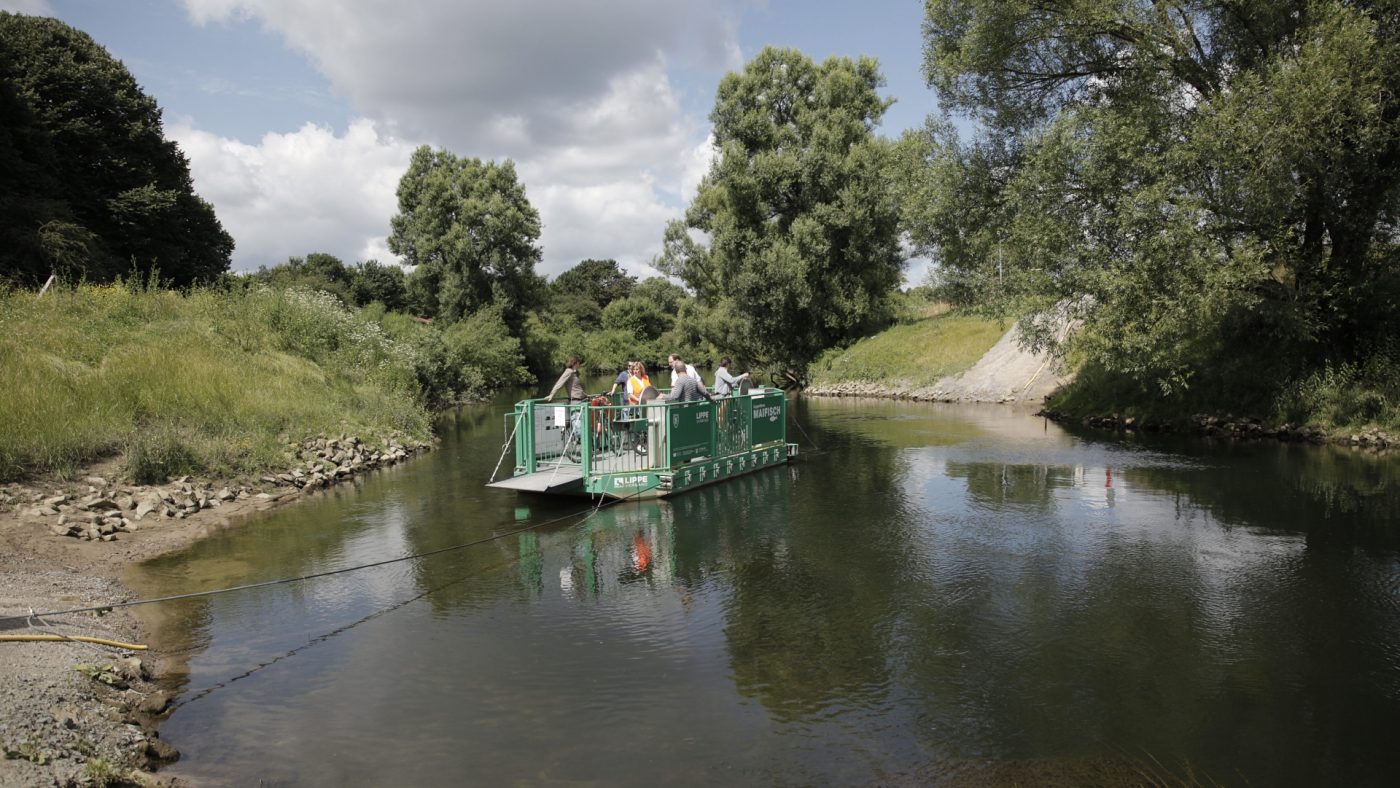
The Lippe is a right-hand tributary of the Rhine. It has its source in Bad Lippspringe, and flows into the Rhine near Wesel after around 220 kilometres. Because of a low change in elevation, the river displays the characteristics typical of a lowland river. The Lippe drains large parts of the Münsterland region
in the Westphalian Bay, and in its lower reaches also the Lower Rhine lowlands. In its upper reaches, the Lippe largely flows through a predominantly agricultural and sparsely populated area. From Hamm onwards, the population density is significantly higher and the surroundings correspondingly more
urban and industrial. The Seseke and some other tributaries of the Lippe were formerly used as open sewers, and are quite similar to the Emscher.
Mining resulted in major water management challenges. The first priority is flood protection, which must be ensured by dykes and pumping stations. But ensuring the ongoing regulation of watercourses that no longer flow independently due to topographical change is also an important task.
Of the 4,882 square kilometre catchment area of the Lippe River, we are responsible for the middle and lower sections, which cover an area of
3,280 square kilometres. This includes a total of around 430 kilometres of watercourses, of which 147 kilometres belong to the Lippe.
